
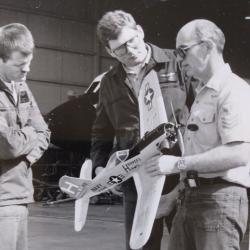
Career of Orin L. Humphries AMA 8142
November 2026
My modeling career began in 1950 as a third grader in Seattle. I bought Comet and Strombecker kits, though it would be not until the 6th grade that I finally got a stick and tissue project together. My sisters would have sword fights with the kit’s stick before that.
As a Cub Scout in the third grade, I needed a hobby to get a merit badge. My mother suggested that I cut pictures of airplanes out of the newspaper and put them into a scrapbook. This hobby continues. My archive filled a small bedroom and has been accepted by the Air and Space Museum in San Diego. It will be delivered next year.
In the ninth grade three of my buddies and I would build Scientific scale models and try to fly them. We got Cox plastic models and tried to fly them, too. But there was no one to coach us on the flying part. The Cox instructions said to give it UP on takeoff. We overdid it, bringing our handles 90 degrees up. The planes made it one-quarter of a lap and crashed.
Over this year and our sophomore year, our total lack of success caused all of my buddies to abandon the flying models. By my senior year, I was the only remaining one. In May, just before graduation, I finally got a Cox J-3 around one and a half laps before crashing due to dizziness. BUT, I HAD FLOWN!
In college I majored in Physics and Math with an eye toward following that up with one in Aeronautical Engineering afterwards. Life, however, led me to teach Science and Math for twenty years, first.
I had afterschool model clubs and introduced them to flying models as a hobby. They number somewhere over one hundred, and I am still in touch with some of them who remain modelers. Several others have contacted me to thank me for leading then into what became their life’s work in Aviation.
I left Teaching to attend the U. of Washington where I received a B. S. in Aeronautical and Astronautical Engineering, Class of ’90.
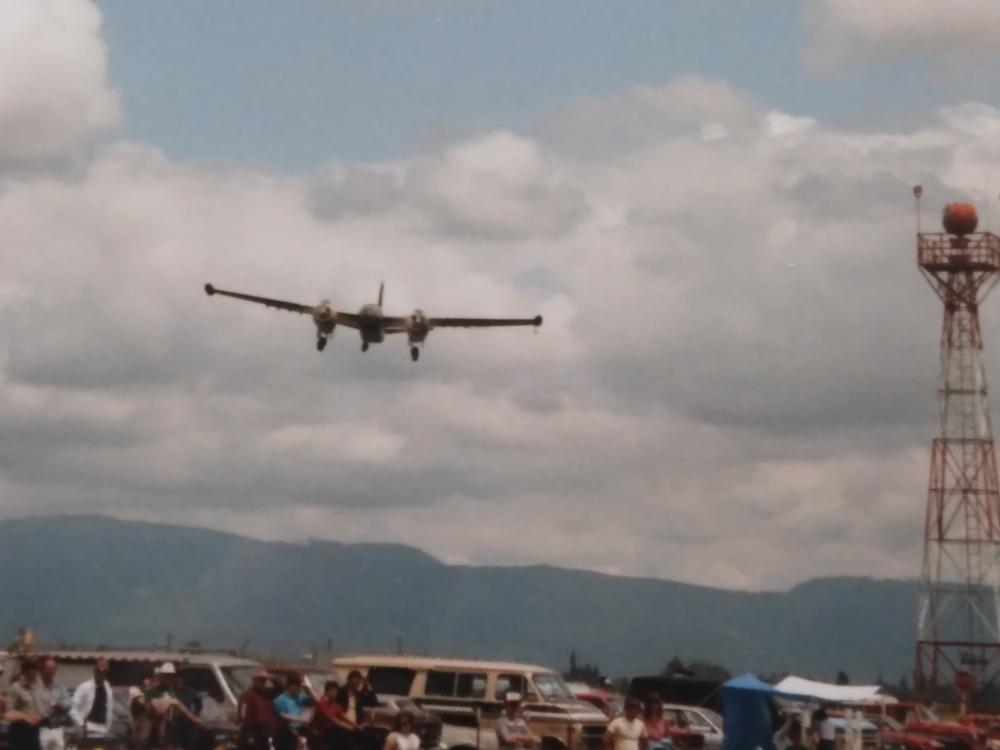
Backing up, now, while I was in teaching, I entered my first CL Scale mode, an A-26C Invader, in 1970 at the Spokane Internats, where it took 2nd against Barry Hobkirk’s Spirit of St. Louis, the reigning Canadian National Champion. Soon, I was a regular entrant into the Northwest Regional Championships in Eugene, Oregon. I flew both Navy Carrier and Scale.
My A-26 over the decades became the Scale scourge of the Western continent.
It never placed below 3rd, and I logged 110 flights over 24 years with it. It competed also in the American Nationals, 1987 and 1989, the Canadian Nationals, the Vancouver Internationals, and the Washington State Championships multiple times. I retired it in 1994 and it is the premier display in the Oregon Air & Space Museum’s models collection in Eugene, Oregon.
My Carrier career brought me to be the Carier Columnist for Flying Lines. My stack of hardcopy printouts of those articles was over and inch and a half thick. During my Carrier career, I solved numerous problems that no one else was able to, and I published them for all to share. One example was when line sliders appeared, deploying them caused the planes to jump uncontrollably up or down, possibly crashing. I invented a lanyard to be attached to the aft leadout between the bellcrank and the guide, which prevented the bellcrank from following the slider when that went aft. I invented a muffler adapter for the K&B 5.8cc engines, and so that went. I held the Profile Class Carrier Record several times.
My Class II Carrier plane, my F2G Super Corsair, set the NW Regional Record in 1976. This stood as the Northwest Regional Resident Record for 35 years.
It was finally broken in 2011 by Mike Potter.
And, while teaching, I created the Spokane U-Control Club there. I became a CD and put on many contests, making many of the trophies myself over those years.
I went to work for Boeing with my Aero degree in 1990, working for six years in the Materials Test Lab. There, I made my first of eight inventions while with Boeing for 18 years altogether. In the lab, I got permission to test the strength of our control line terminations as an independent check.
This was at the time we had been using insulated lines for adding electronically controlled functionality to our Scale models. Also, AMA was considering whether or not to allow 2.4gHz radio systems for that capability.
My tests showed that the terminations for bare lines were per the published strengths, but I discovered a fatal flaw with the insulated lines’ terminating. The wire was pulling out of the plastic sheath for one of the three listed methods. I called the committee at AMA and shared this information with them. This brought about the abandonment of insulated lines and the adoption of the 2.4gHz radios. This and my becoming and Aeronautical Engineer led to my being designated a Scientific Member. My CD ticket gave me Leader Member. I had become the AMA District 11 F4B Board Member.
I moved to Seattle to work for Boeing and the lack of handy flying fields led me to leave modeling for a while. When I returned to modeling, I left Carrier to focus on my neglected Scale building.
Along the way, I entered my N2S Navy Stearman in the 2023 Nats. Nobody was doing High Flight as an option that I was aware of. Over my three flights there, I worked my Stearman up to a sustained three-laps at 60 degrees.
Others attempted that, but nobody came close, finding it hard to maintain 30 degrees. Since then, many others are opting for High flight at the Nats, but no one has reached my Stearman’s sustained 60 degrees that I’m aware of.
I had become the Scale columnist for flyinglines.org around 2012. I focused on solving building and flying problems, publishing 33 articles, which covered 95 topics. A selection of these appears below.
But let me first say that before I became Scale columnist for flyinglines.org, Scale turnout at the Regionals had fallen off to three or four models. With my published solutions, turnouts have steadily grown there, setting a record at the 2026 contest at fifteen Scale models across all Classes.
K&B
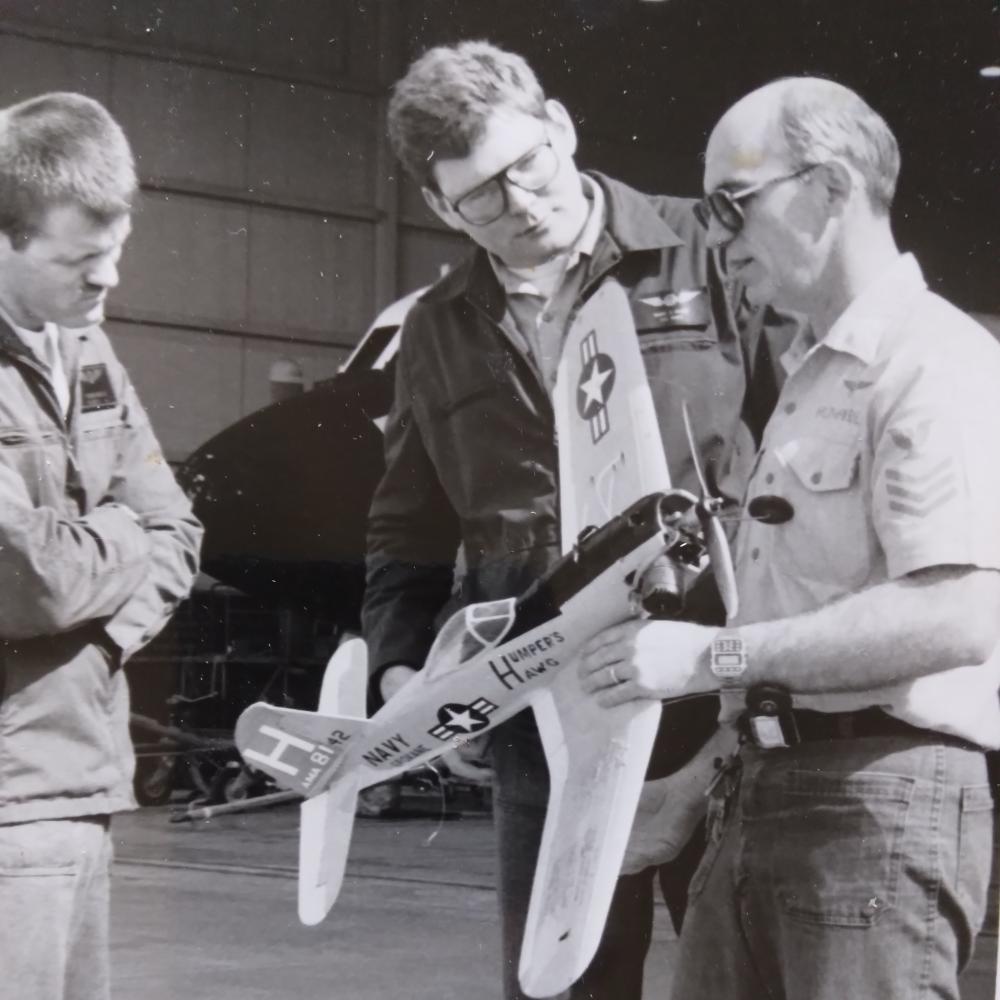
Near the end of my Carrier career, K&B sent me two prototype engines for pre-release field testing. These would be called the “Sportster Series”.
I determined that the .28 Sportster was field-ready, but their .61 Sporster was badly out of balance and could not yet be released.
I consulted with K&B and Klass-Kote Epoxies about an undiscovered way that a “fish-eye” condition can arise when spraying their paints. I had discovered that the spray stream between the airbrush and the model entrained atmospheric gases. These gases included water vapor. The water was deposited into the paint layer. If a drying film formed over the paint layer before the water inside the layer had time to evaporate, fish-eye occurred. I counseled them to advise the use of a retarder, such as sold by Sig, to delay the forming of the outer film. Klass-Kote solved this by adding more of their reducer.
Reed valve 1/2-A
Reed valve 1/2-A scale models had all but disappeared from the Regionals and the Nats. I spent two seasons researching the historic problems that they were notorious for, like why do they start and tune, and they run only until you get to the handle and pick it up, then it dies, and there is still plenty of fuel in the tanks? (Don’t tune them with the clip on; only with the clip off. The clip supplies artificial heat and the engines cool off without it.) At the next Regionals, the ED observed in amazement, “There were three 1/2A models entered this year, they all were twins, and all of the engines ran throughout all of the flights.” These models reappeared at the Nats later that year with the same results and have sustained their presence.
Hanging from the lines: CL builders had historically brough out the leadouts from the wingtips no matter what the general arrangement of the aircraft.
This was totally oblivious to the vertical location of that model’s CG.
This caused some models to be rolled in toward the pilot, weakening the line tension. A gust on the upwind side of the circle caused many a crash when the leadout guide was located above the CG. I published many photos of how to hang the model from its leadouts before final completion to establish the proper roll angle. “How it hangs from the leadouts is how it sits on the lines in flight.” - OLH Paint Runs Spray painting our models has always been plagued with paint runs. I asked a Mechanic of full-size airplanes how they avoid paint runs. He shared that they always start with a coating that is known by either of two names: “Tack Coat” and “Mist Coat”. This is where the first coat is only a mist, no effective coverage at all. You let this dry a matter of some seconds, depending upon the type of paint and the thinner ratio, until it literally feels tacky. Then you spray on the first coverage coat. Do not attempt one-coat coverage. The tack coat reaches up into the coverage coat and grabs onto it. This effect only goes up so far, and it cannot prevent a heavier application of that first coverage coat from running.
Trap Tanks
If your model has a clunk tank and you are using muffler pressure, you need a “trap tank” between the muffler and the fuel tank. When your engine is running, you will notice small droplets of oil coming out of the muffler and going up through the pressure tube. These go into the fuel tank. We have always falsely believed that the oil would just mix in with the fuel in the tank. It does not. Mixing requires the addition of energy to dissolve the castor oil. That’s called Entropy. The oil accumulates in the clunk tank and becomes a small pool of unmixed thick oil. After just a few flying sessions the oil pool becomes large enough to block the pickup end of the feed line. The engine will run out its prime but not sustain running. You will wrongly guess that you have some classical blockage in the fuel system that is external to the tank. Before that may happen, you will be slow on approach about four feet off the ground, and the engine will suddenly die.
The clunk has fallen down into the oil pool and blocked the pickup.
You need to install a small 1/2A tank between the muffler and the fuel tank to trap this oil. The trap tank will need a drain tube to remove the accumulated oil every few flights.
Propellor Selection
In my December 2021 Scale Column, I published that we have badly misconstrued the basis for our choice of propellors. We have historically believed that if we go from a 10-6 to a 10-7 prop, the model will fly faster. We believed that if we instead went to a 10-5 prop, the model would be slower. The opposite is true. Our mistake is in tying ourselves too tightly to these matters in full-size aviation.
The full-size planes’ engines run in a very tight rpm range due to thermal limits. Their engines’ power outputs stay within a narrow range. None of this is true for model airplane engines.
We tune to best mixture, not the same rpm, when we try different propellors.
Going down one pitch from 10-6 to 10-5 lets the engine turn at least 1,000rpm higher. The engine is now higher on the power curve; it is putting out more mower. More power means faster speed, not slower.
Examples: My Shoestring Stunter, K&B Sportster .28, with a 9-6 prop was weak going over the top of a wingover. I put a 9-4 prop on it. It flew much faster and it owned the wingover. However, it was too fast during the rest of the flight. I then put a 9-5 prop on it. That slowed it down a bit, but it still did wingovers nicely.
World Championships
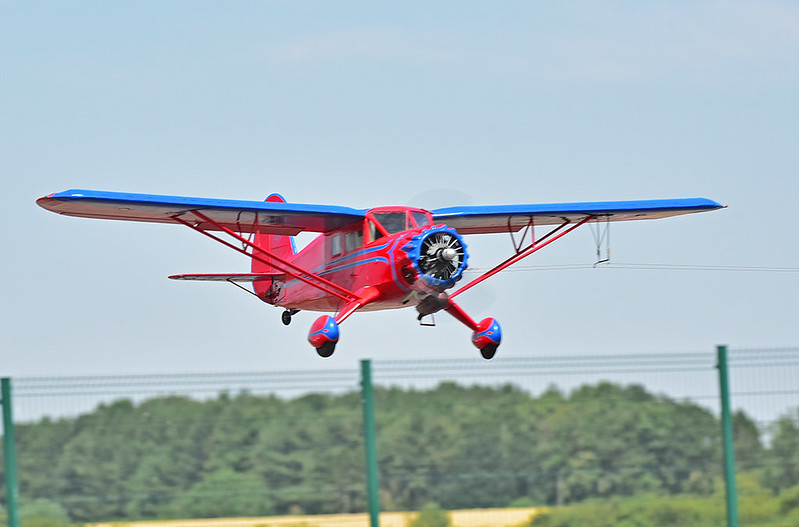
In 2025 at the Nats, I qualified for our F4B Team for the 2026 Games to be held in Buckminster, UK. I flew my Stinson SR-6 there, and we won Team Silver Medal.
In the Championships, I introduced for the first time, ever for a C/L Scale model, two new manoeuvers. The first is S-Taxi, having a steerable tail wheel like the full-size planes do. It is incredibly difficult to get everything right to do a scale S-taxi.
The second was Wing-Wag, using ailerons.
To my knowledge, no other Control Line model has ever done these two manoeuvers.
I will try to qualify again at the Nats in 2027 for the Games in Poland in 2028.
Other Accomplishments.
While at Boeing I worked the last twelve years of my career on the 777 Line.
There, I made the last seven of my eight total inventions, receiving U. S. Patents for some and Boeing put some others in Proprietary Reserve. I engineered the fixes for 650 777’s that developed problems coming down the Line. My Inventions and other considerations let me meet the qualifications for Associate Technical Fellow.
Aviation Author/Historian
I wrote the document that became the world gold standard of the Lockheed
SR-71 Blackbird, which explained how the aircraft worked, and the Air Force adopted it for their crews.
I became the historian for the U-2 squadron, publishing their history. Kelly Johnson invited me to come to the Skunk works after these works. I have a total of five major works published in Wings and Airpower Magazine. These, with the two above, include Soviet maritime reconnaissance aircraft, in which I corrected Jane’s All the World’s Aircraft on the subject, the history of drones, and the aeronautics of modern blimps.
I served as an aircraft restorer for Seattle’s Museum of Flight where I restored old airplanes. I then served as Lead Historian and STEM Focal for the Historic Flight Foundation at Paine field, Washington for six years. I have now been with the Heritage Flight Museum at Burlington, Washington, for four years, where I am their “Resident Historian”, and I serve as their Assistant to the Curator for their Model Collection and other Museum functions.
I served 23 years, four months, and 23 days as a Naval Air Reservist, mostly in Lockheed P-3 Orions. We chased Russian subs, and I was decorated for serving in anti-drug boat missions in Panama, where the druggers shot at us, and we took casualties. I relieved the aircrew near the end of long search missions and flew search patterns in the P-3 myself. At my last advancement, I was promoted to Number One Senior Chief in the Naval Air Reserve.

