
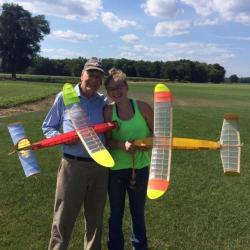
My life in Model Flying is actually owed all to my grandfather, so I guess this is more our story than just mine. His name was Stanley Colson. My grandfather was raised in East Boston as a kid. But when he was 4 his family moved to Everett, just north of Boston, where he would meet a neighborhood boy, Martin Phillips, who invited him to go model flying with him and his father. This invitation sparked a lifelong passion of designing and building model airplanes.
As his love for aviation grew, he competed in the Jordan Marsh-Boston traveler Junior Aviation League (JAL) contest with his best friend Harry Keshishian, during high school in the late 1930s - he claimed fifth place over the Flying Scale Model and came in first with overall scale points.
In 1942, members of JAL were invited to use their expertise in designing model airplanes to aid in the Navy's model plane building program at Langley Memorial Aeronautical Laboratory in Virginia. He would use his skills and knowledge he had learned so far, to aid in research done by MIT designing model wings that helped to increase the speed and aeronautics of these models in a wind tunnel, amount other activities. But on November 19, 1942, he enlisted in the U.S. Army at Fort Devens in MA and he would send his paycheck back to Ruth, his mother, to help make mortgage payments. His tour with the 903rd Air Engineer Squadron included Scotland, England, France, Belgium, Germany, and Holland. He would meet his life-long wife in Germany at a park outside of a local Lutheran church after one of his fellow soldiers had passed. They would write letters delivered by another fellow soldier. In later years, Stan would propose to Elsbeth through a letter and he sent her engagement ring over in a bag of flour!
Prior to their engagement, he went to the New England Aircraft School from ’46-’48 and completed classes to become a Master Mechanic. Once discharged from the Army, he worked at General Steele in Everett making grocery carts and could make up to 24 per hour, more than many of his colleagues!
After being discharged from the Army, he would find himself being arrested for trespassing at Hanscom Field Air Base, where he went looking for someone to help straighten out some misfiled discharge paperwork. He would be offered a job on the Hanscom Airforce Base from a fellow soldier who knew him during the war. In 1951, he was called to serve in the Korean War, this time to the Ninth Airforce as part of the Army Airforce—he moved his wife and eldest son to New Mexico and again worked on models. He returned to Hanscom Airforce base after the Korean War and worked there until the base closed in 1973. In 1978, he would come to work at a sheet metal shop at the Lincoln Lab in Bedford creating J-Stars and weather balloons. Here he would remain until 1985, when he retired to painting houses in his early sixties.
He flew as President and co-founder of the New England Wakefield Group (NEWG) outdoor model club, founded in 1953. He spent much of his retirement caring for his grandchildren. He enjoyed attending their sporting events and becoming a grandfather figure to many of their friends. After he retired, he concentrated on his model flying, which gave him time to bond with his family in early retirement. This is where my story starts as his granddaughter.
My sister and I have been model flying with my grandfather since we could stretch the rubber to fly a glider. When I was in 8th grade, we built my first P-30 together and I would later go on to help and fly tow line with him when he felt he could no longer run in his early 90's. We have many memories driving down to Cape Cod in Massachusetts, where we would fly with his group - NEWG. We would also drive down to the farm in Connecticut with Sam-7. Most of the summers the dates were coordinated since many of the guys flew in both leagues - my grandfather's and Sam. When we had to give up the field on the Cape Cod when I was in high school, we only fly with the Sam-7 group in Connecticut.
The back porch upstairs was dedicated just to his model flying. Planes, rubber, balsa wood, and tissue paper everywhere, he built his model by hand and created all the parts into his early 90's. We would drive 2 hours to Connecticut on Model Flying Days until COVID when they postponed the meets. He flew one last time at the age of 96 once the meets started again.
Stanley attended 3 AMA National Championships meets—he placed five times, including one first place. He was a member of SAM 7 (Society of Antique Modeler) in CT; during his retirement years he was the club free flight high point champion nineteen times. He went to one Sam National Championship and placed fifth. Trophies and memories that continue to hang on the walls and sit on the shelves where they are treasured.
I haven't won as big of trophies as my grandfather has, but I have received my fair share of event wins to stick to my Sam 7 plaque. By the time I was old enough to compete my grandfather has stopped traveling and priorities had changed to taking care of his handicapped son and ill wife.
To this day, his back porch of model supplies still sits almost as he once had it. I try to fix the places that I have flown since he passed and I have tried to dabble myself into his massive knowledge of model aeronautics. I sit in his place sometimes when I just need a breather and remember the charitable, big-hearted, munificent father and grandfather that he was to his own boys and to me and my sister. Many of my best memories when I was younger revolve around aeronautics and model airplanes and what a huge part of being together on those weekends met to my grandfather and the guys he flew with.

