
I was born in Pittsfield, Massachusetts—a poor kid with a funny French last name. Little did I know that three famous gallic aviators would pique my imagination and shape my destiny.
Louis Blériot, the first to fly across the English Channel in 1909. As a wee child, I pictured myself sitting in the bottom of his daring creation, waving at the peasants below as I flew over the white cliffs.
Later, I read Antoine de Saint-Exupéry's exciting stories of daring flights that I replicated in my dreams.
But ultimately, it was Henri Farman, early aviation pioneer and winner of the first official airplane race, that really dominated my thirst for invention and discovery.
In the beginning, I devoured every page of the one magazine that mom could afford each month. One month, Model Airplane News with full-page plans would tempt me. At home, I'd mark up the changes I'd make if I ever had the resources to start building one of my own. But sometimes, the stories in Air Trails would draw me in and that would be my selection. Rarely, there would be funding for an actual Comet or Guillows kit. But after much inner debate and consultation with my peers, a selection would come home with me from Kirk's Hobby Shop. Armed with single-edge razor blades, Ambroid cement, and any kind of tissue I could find, a model would eventually emerge. Alas, though my efforts looked similar to the box photo, actual flights similar to those reported in the magazines eluded me.
But also in those days, my friend and I would use the plans for Free Flight models: cut them out, same size, from 1/16-inch balsa sheet and balance them with "engines" made from empty glue tube ends. I can't claim that we really understood why the mystic CG had to be where the funny circle indicated, but those were our best flyers.
Oops, I failed to mention that we had an enormous sand bank from which we would launch our creations, often sailing far enough away to be lost forever. Never do I recall encountering a thermal.
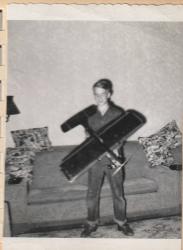
As the years progressed, I was more or less successful with building FF and CL models from plans ordered from the magazines. And always, I was tempted to add my touch to the originals. At the beginning of this biography is a photo of me holding a CL Stunt model kit (Tomahawk?) in my early teens.
Time marched on and military service and early years of marriage responsibilities intervened, but one fateful day (my wife has other descriptors of that event), far in the distance, I heard the unmistakable roar of a Dynajet in a CL contest in Winston-Salem, North Carolina—and I was hooked anew.
That started my Golden Years. I joined an AMA club in 1974, and CL stunt, carrier, racing, and combat competition took over.
R/C entered my life later in that decade and has stayed there ever since. My first efforts were modest, to say the least. All built from plans and those early efforts were rudder/elevator designs powered with Cox engines (with which I had much experience and inventory from my CL days).
I couldn't begin to list all the models I built in my gas and glow days. "Too many to list," as an auctioneer might say. A few stand out as pure fun favorites. Telemasters of all sizes and Lazy Bees ... there were many, many others.
Then, the electrics beckoned. Initial efforts with heavy batteries and "can" motors were less than exciting. But every few months, I'd try again ... then LiPos, ESCs, and outrunner motors changed my life forever! And I'm never going back.
Now, I am in an electric-only club with many kindred spirits, and I can design, build, and fly a new model in a week if so inclined. Okay, maybe half of my efforts are less than stellar successes, but this is what the best of the hobby has become for me.
I am reminded of the old AMA film: "I build 'em, I fly 'em, I break 'em, I fix 'em." It keeps me young ... pretty much.

